India’s space legacy is a monumental narrative of scientific determination and national aspiration-a journey that began with hand-carried rocket parts in the 1960s and has now evolved into a multi-dimensional space ecosystem influencing global exploration, commercial markets, and international cooperation.
The launch of Aryabhata in 1975, conceived during the visionary leadership of Dr. Vikram Sarabhai and Prof. Satish Dhawan, marked the moment India transitioned from a developing nation to an emerging technological powerhouse. Their philosophy-that space must serve both scientific advancement and the socio-economic development of humanity-laid the foundation for a programme rooted in indigenous engineering, mission autonomy, and satellite applications for education, disaster management, communication, and national resilience.
India’s early engineering achievements established the fundamental architecture of its space capability. Vehicles such as SLV-3, ASLV, PSLV, and the later GSLV family integrated multi-stage propulsion stacks, precision flight control systems, high-efficiency solid motors, cryogenic upper stages, strap-on booster augmentation, and advanced inertial guidance technologies.
The PSLV, known for its exceptional reliability index and orbital accuracy, became the backbone of India’s launch services, enabling not only national missions but also commercial launches for dozens of countries-democratizing access to space for emerging spacefaring nations.
India’s scientific milestones expanded rapidly in scope and ambition. Chandrayaan-1’s discovery of lunar hydroxyl signatures fundamentally altered humanity’s understanding of lunar geology and water-cycle distribution in near-vacuum environments.
The Mars Orbiter Mission (Mangalyaan) demonstrated a mastery of interplanetary navigation, delta-V optimization, gravity-assist trajectories, deep-space communication bandwidth management, autonomous fault-correction algorithms, and long-duration spacecraft health monitoring-achieved at a cost efficiency that astonished the global space community.
Earth-observation missions featuring hyperspectral imaging, synthetic aperture radar (SAR), ocean colour monitoring, microwave radiometry, and atmospheric profiling now support agriculture planning, monsoon modelling, fisheries forecasting, coastal resilience, and global climate studies.
A new chapter in India’s legacy is marked by its advancements toward human spaceflight. The Gaganyaan/Suganyan Integrated Main Parachute Airdrop Test, executed with scientific precision, validated critical recovery technologies involving drogue and main parachute deployment, reefing-line structural behaviour, terminal descent velocity calibration, canopy load distribution, and crew module deceleration dynamics.
These tests reflect India’s growing expertise in re-entry erothermodynamics, life-support architecture, crew module avionics, environmental control systems, and human-rated reliability engineering. With each test, India advances closer to placing Indian astronauts in Low Earth Orbit using entirely indigenous hardware.
Equally transformative is the rise of India’s new-space private sector-a phenomenon reshaping the country’s space trajectory. Companies such as Agnikul Cosmos, Skyroot Aerospace, Dhruva Space, Bellatrix Aerospace, Pixxel, and several emerging startups represent the accelerating heartbeat of India’s commercial space revolution.
Agnikul’s fully 3D-printed semi-cryogenic engines, Skyroot’s modular small-lift launch vehicles, Dhruva Space’s satellite buses and deployer systems, Pixxel’s hyperspectral imaging constellation, and Bellatrix’s electric propulsion systems exemplify India’s ability to create world-class, fast-cycle, innovation-driven technologies.
The influence of venture capital, deep-tech investment funds, global incubators, and government-backed accelerators has further expanded India’s space manufacturing capacity, enabling rapid prototyping, mass production of nanosatellite components, propulsion system testing, and private launch operations.
This ecosystem now works in synergy with ISRO, providing complementary strengths: ISRO brings institutional scientific depth and mission heritage, while private companies bring agility, fast iteration cycles, and competitive commercial offerings. Together, they position India as one of the world’s fastest-growing, multi-actor space economies.
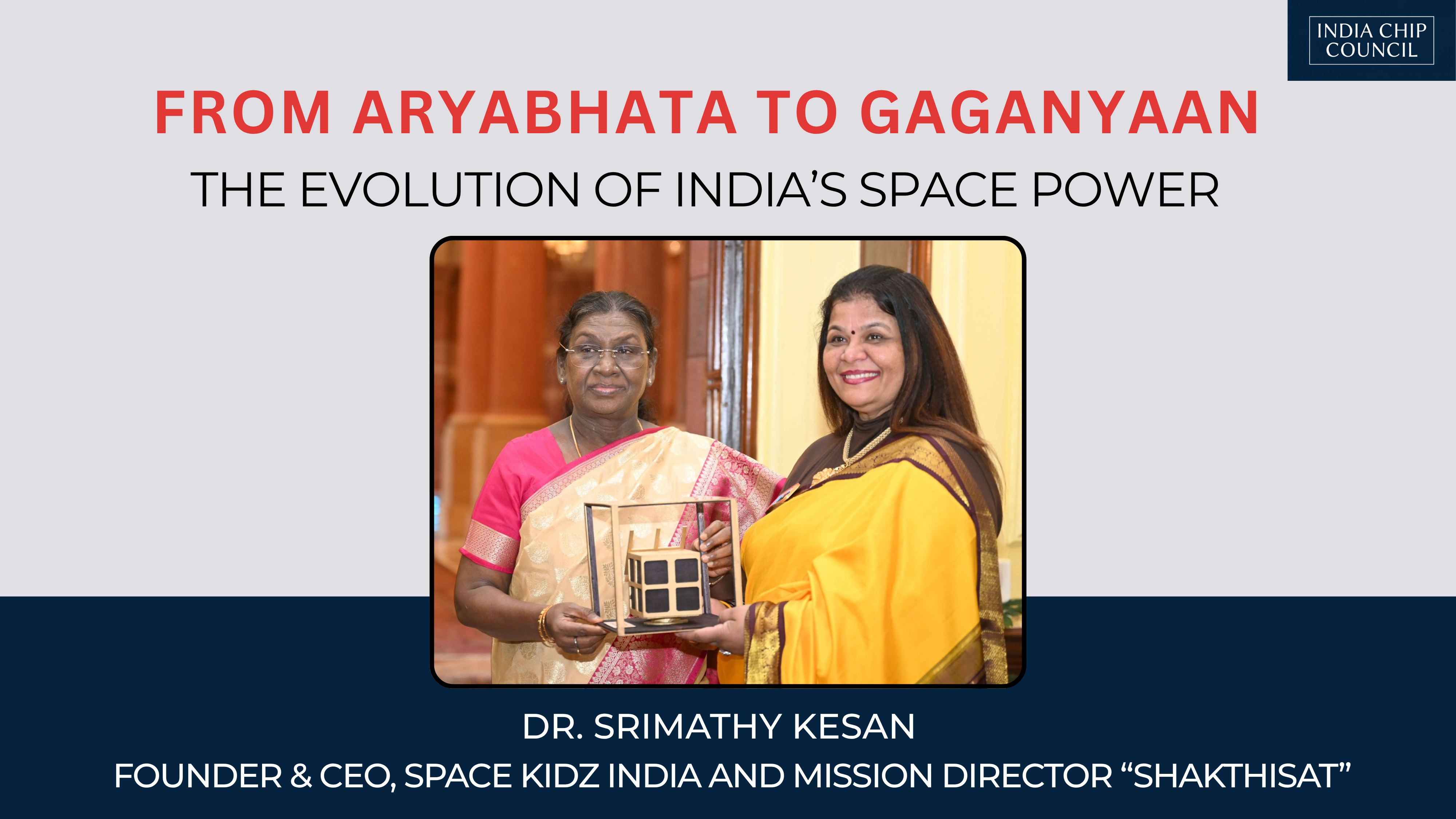
But perhaps the most extraordinary aspect of India’s space legacy is its ability to merge scientific ambition with global humanitarian values. The historic ShakthiSAT initiative, involving an unprecedented 12,000 girls from 108 countries, is one of the largest gender-inclusive space science programmes ever conducted.
This mission empowered young students to learn satellite design, payload development, signal processing, and orbital experiment interpretation-allowing thousands of girls to see themselves as future aerospace leaders. By involving students from diverse cultural, economic, and geographical backgrounds, the programme symbolized India’s commitment to global inclusivity and scientific equality.
Further strengthening this legacy is Space Kidz India’s “Impact Project,” one of the most significant youth satellite platforms in the world. The project trains students in structural design, electronics, telemetry, communication systems, experimental payloads, thermal testing, and mission integration, preparing the next generation of engineers, scientists, and innovators.
What makes Impact particularly meaningful is its philosophical foundation in “Vasudhaiva Kutumbakam”-the ancient Indian idea that the entire world is one family. Through this project, students collaborate across nations, cultures, and disciplines, strengthening India’s identity as a nation that builds scientific unity and global harmony through space.
Today India stands on the brink of a new era. With the national space economy projected to reach $44 billion by 2033-driven by IN-SPACe reforms, FDI liberalization, private launch pads, commercial human spaceflight, reusable rocket development, space manufacturing, and deep-space ventures-India is emerging as a global centre for innovation, investment, and scientific collaboration.
The combination of ISRO’s mission heritage, private-sector dynamism, and youth-driven global programmes like ShakthiSAT and the Impact Project forms a powerful triad that will shape India’s future in the space age.
India’s space legacy is no longer just a record of achievements; it is an expanding force that influences global science, commercial space markets, education, diplomacy, and humanity’s collective exploration of the universe.
From cryogenic engines and interplanetary missions to private launch vehicles and the empowerment of 12,000 girls across 108 countries, India’s journey stands as a testament to what a nation can achieve when engineering excellence, scientific curiosity, and the spirit of Vasudhaiva Kutumbakam come together to build a better future for all humankind.
Dr. Srimathy Kesan is the Founder & CEO of Space Kidz India and Mission Director of ShakthiSAT. A pioneer in youth space education, she has led groundbreaking initiatives empowering thousands of students worldwide to explore satellite technology and space science. Through her visionary leadership, she champions inclusivity, innovation, and India’s spirit of Vasudhaiva Kutumbakam, inspiring the next generation to look to the stars with purpose and unity.


Leave a Reply