Quantum technologies are emerging as a defining force of the 21st century, with the potential to reshape national security, economic competitiveness, scientific leadership, and technological sovereignty. For India, a nation with strategic ambitions, a rapidly digitizing economy, and a strong base in science and engineering, quantum technologies are not merely a futuristic pursuit but a strategic necessity.
At its core, quantum technology leverages principles such as superposition, entanglement, and quantum interference to perform tasks that are infeasible for classical systems. These principles enable breakthroughs across quantum computing, quantum communication, quantum sensing, and quantum materials. Each of these domains has direct relevance to India’s long-term national priorities.
From a strategic and security perspective, quantum technologies are critical. Quantum computing threatens to break widely used public-key cryptographic systems, posing risks to government, military, and financial communications. For India, which is rapidly expanding digital public infrastructure such as Aadhaar, UPI, and government cloud systems, the transition to quantum-safe cryptography is essential to protect national data assets. At the same time, quantum communication particularly Quantum Key Distribution (QKD) offers the promise of theoretically unbreakable secure communication networks, which are vital for defence, space, and strategic command-and-control systems.
Economically, quantum technologies represent a high-impact opportunity for India’s innovation ecosystem. Quantum computing can dramatically accelerate optimization, simulation, and machine-learning tasks relevant to sectors such as pharmaceuticals, materials science, logistics, energy, and finance.
For example, quantum simulations can enable faster drug discovery, improved battery materials, and more efficient fertilizer and chemical processes areas of direct relevance to India’s healthcare, energy security, and agricultural productivity. Early investments can help Indian startups, research institutions, and industry become global contributors rather than late adopters.
India’s strong talent base in mathematics, physics, computer science, and engineering provides a natural advantage. Decades of excellence in theoretical physics and information science, combined with a mature IT services industry, position India well to contribute across the quantum value chain from algorithms and software to hardware control systems and applications. Initiatives such as the National Quantum Mission reflect a recognition that sustained public funding, coordinated research, and industry participation are essential to translate academic strength into national capability.
Quantum sensing and metrology also hold significant promise for India. Ultra-precise quantum sensors can improve navigation without GPS, detect submarines and underground structures, enhance mineral and water resource exploration, and enable better climate and seismic monitoring. These capabilities are particularly valuable for a geographically diverse country like India, with long coastlines, seismic zones, and complex border terrains.
Finally, quantum technologies are about strategic autonomy. As global competition intensifies, nations that control foundational technologies will shape future standards, supply chains, and geopolitical influence. Dependence on foreign quantum hardware, software, or cryptographic systems could create long-term vulnerabilities. Building indigenous quantum capabilities aligns closely with India’s broader goals of technological self-reliance and strategic resilience.
In conclusion, quantum technologies are not optional for India they are imperative. Their impact spans national security, economic growth, scientific leadership, and strategic independence. By investing early, nurturing talent, and fostering collaboration between government, academia, and industry, India can position itself as a leading quantum power shaping not just its own future, but the global quantum landscape.
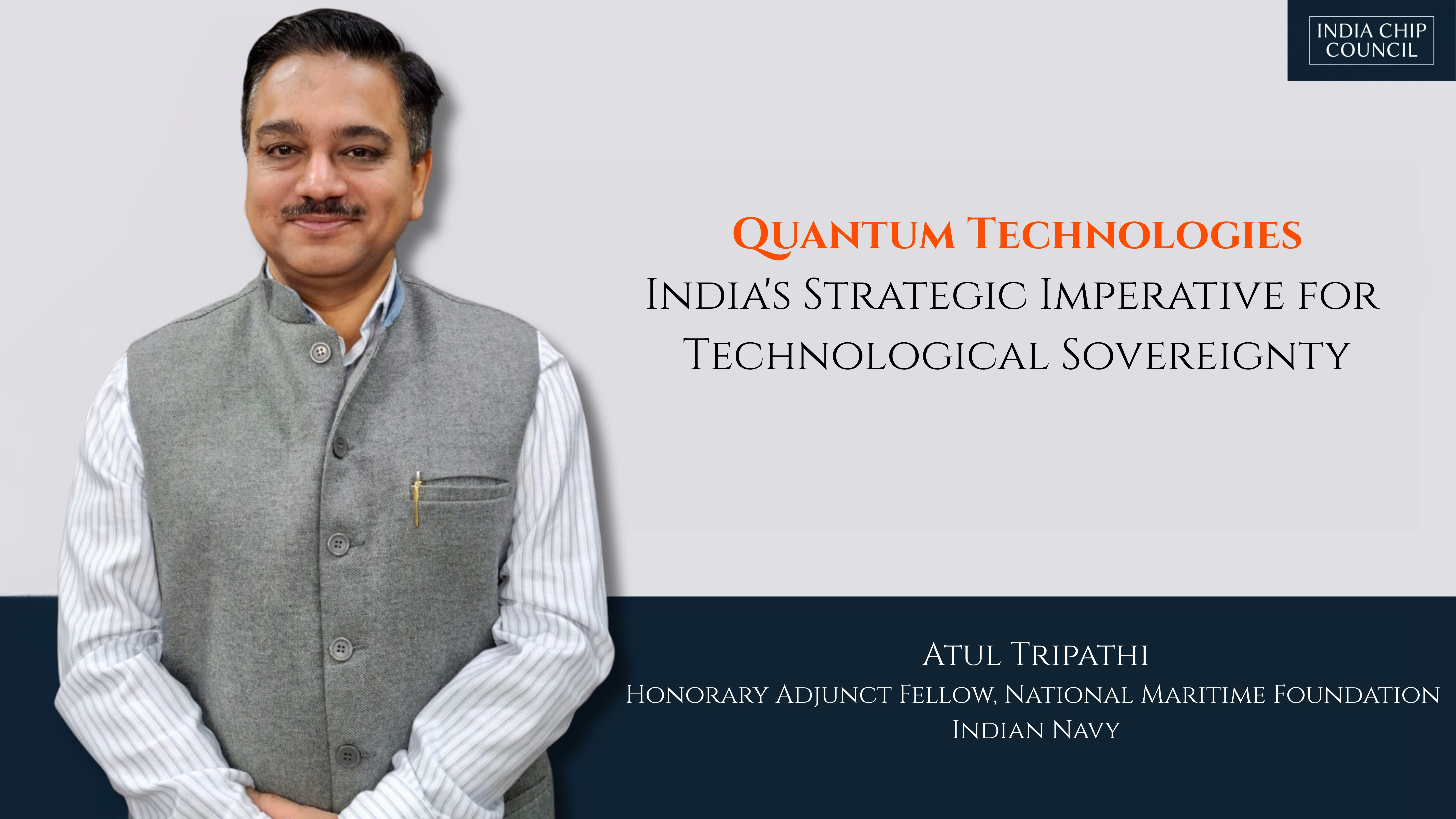
Atul Tripathi is an Honorary Adjunct Fellow at the National Maritime Foundation, Indian Navy, with deep hands-on expertise in Artificial Intelligence, Machine Learning, and Data Analytics. He works closely with the Government of India on AI-driven policy research and strategic frameworks across governance, security, finance, infrastructure, and emerging technologies.



Leave a Reply